


Have you ever looked at your 9-to-5 desk and wondered, “Is this it?” Or perhaps you’ve dreamed of a life where you control your schedule, choose your clients, and work from anywhere in the world—but the fear of “financial instability” keeps you stuck. You aren’t alone. Millions of professionals are currently standing at the edge of the “Freelance Revolution,” asking the same question: How do I transition from a traditional job to a successful, high-income freelance career without losing my mind?
In this comprehensive guide, we will pull back the curtain on the world of freelancing. As a Chartered Management Accountant (CMA) with over 8 years of experience, I’ve seen both sides of the coin. At CountHive, we help freelancers manage the very thing that scares them most: the numbers.
Let’s turn your skills into a scalable business.
1. What is Freelancing? (The 2026 Perspective) 🌍
In 2026, freelancing is no longer just a “side hustle.” It is a sophisticated global economy. A freelancer is an independent contractor who provides services to multiple clients rather than being committed to a single employer.
The Shift in the Gig Economy
Today, companies aren’t just looking for “cheap labor”; they are looking for specialized experts. From AI prompt engineering and blockchain development to expert financial consulting, the barrier to entry has shifted from “can you do the work?” to “can you provide the strategy?”
2. Step 1: Identifying Your High-Value Niche 🎯
The biggest mistake new freelancers make is being a “jack of all trades.” If you offer “General Writing” or “Basic Accounting,” you are competing with everyone on price. To win, you must niche down.
- Generalist: “I do bookkeeping.”
- Specialist: “I provide cloud-based bookkeeping for SECP-registered tech startups.”
By specializing, you become an authority. As I’ve learned in my 8 years as a CMA, clients don’t just pay for your time—they pay for your specific expertise in solving their unique problems.
3. Building a Digital Presence That Sells 💻
Your “resume” is dead. In the freelance world, your Portfolio and Personal Brand are your currency.
Your Professional Toolkit:
- A Clean Website: Your home base (like CountHive) where you control the narrative.
- LinkedIn Optimization: Use a professional headshot and a headline that focuses on the result you provide (e.g., “Helping Agencies Increase Profit Margins by 20%”).
- Platform Presence: Whether it’s Upwork, Fiverr, or Toptal, pick one platform and master its algorithm before spreading yourself thin.
4. The “Freelance Trap”: Managing Your Finances 💰
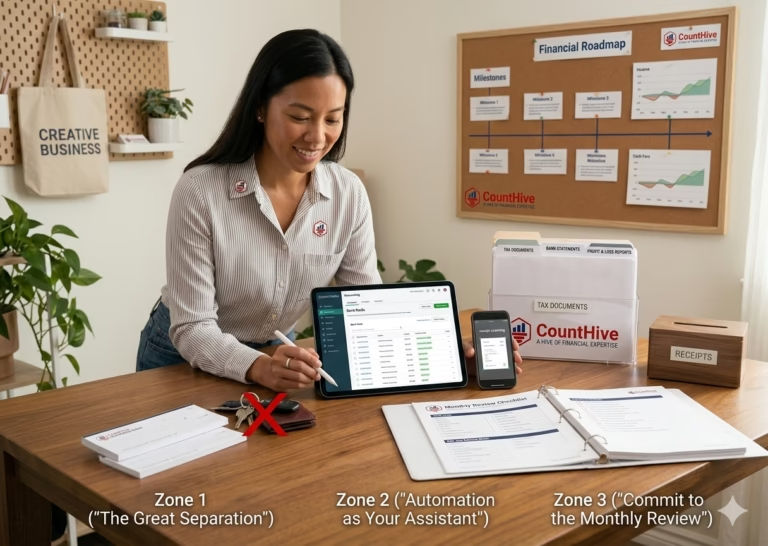
This is where most freelancers fail. They treat their business bank account like a personal piggy bank. 🚩 Red Flag! 🚩
Actionable Financial Tips:
- The 30% Tax Rule: Always set aside at least 30% of every paycheck into a separate “Tax Vault.”
- Understand Your “Burn Rate”: How much do you need to earn per month to cover your rent, software, and health insurance?
- Value-Based Pricing: Stop charging by the hour. An hour of an expert’s time is worth more than an hour of a novice’s time. Charge based on the ROI you provide to the client.
5. Client Acquisition: Beyond Cold Emailing 🤝
How do you get clients when you have zero reviews?
- The “Loom” Strategy: Instead of a text email, send a 2-minute video (using Loom) showing the client exactly how you can improve their business.
- Networking via Content: Post one valuable tip on LinkedIn every day. When you provide value for free, clients come to you.
- Referral Loops: Offer a 10% discount to current clients if they refer a new one. Word-of-mouth is still the strongest marketing tool in existence.
6. Staying Productive (Without the Burnout) 🧠
Freelancing gives you freedom, but it can also lead to working 24/7. To stay successful, you must manage your energy, not just your time.
- Time Blocking: Use tools like Google Calendar or Notion to block out specific hours for “Deep Work” vs. “Admin Tasks.”
- The “Founder” Day: Spend one day a week (Friday is great!) working on your business (marketing, learning new skills) rather than in your business (client work).
7. Scaling Up: From Freelancer to Agency 🚀
Once you hit your capacity, you have two choices: raise your prices or start a team. This is exactly how CountHive grew. We transitioned from individual consulting to a registered firm providing end-to-end accounting services.
Scaling requires systems. You need Standard Operating Procedures (SOPs) so that the quality of your work remains high even when you aren’t the one doing every single task.
Summary: Your Freelance Launchpad 🎯
Freelancing is a marathon, not a sprint. It requires the discipline of an employee and the vision of a CEO.
Main Takeaways:
- Niche Down: Be the big fish in a small pond.
- Brand Yourself: Your reputation is your most valuable asset.
- Master the Numbers: Keep your books clean from day one.
- Automate: Use AI and software to handle the boring stuff so you can focus on the creative stuff.
Ready to take the leap? Don’t wait for “the perfect time.” Start building your side hustle today, and by this time next year, you could be your own boss.